The Termite and the Elephant is a sculptural exploration of interspecies collaboration and planetary care. Drawing from the vibrational communication of termites and the seismic presence of elephants, the work traces how abandoned termite mounds are transformed—through weight, repetition, and time—into generative landscapes. The sculpture translates these unseen exchanges into a speculative object, framing ecology as a record of resonance, memory, and mutual dependency.
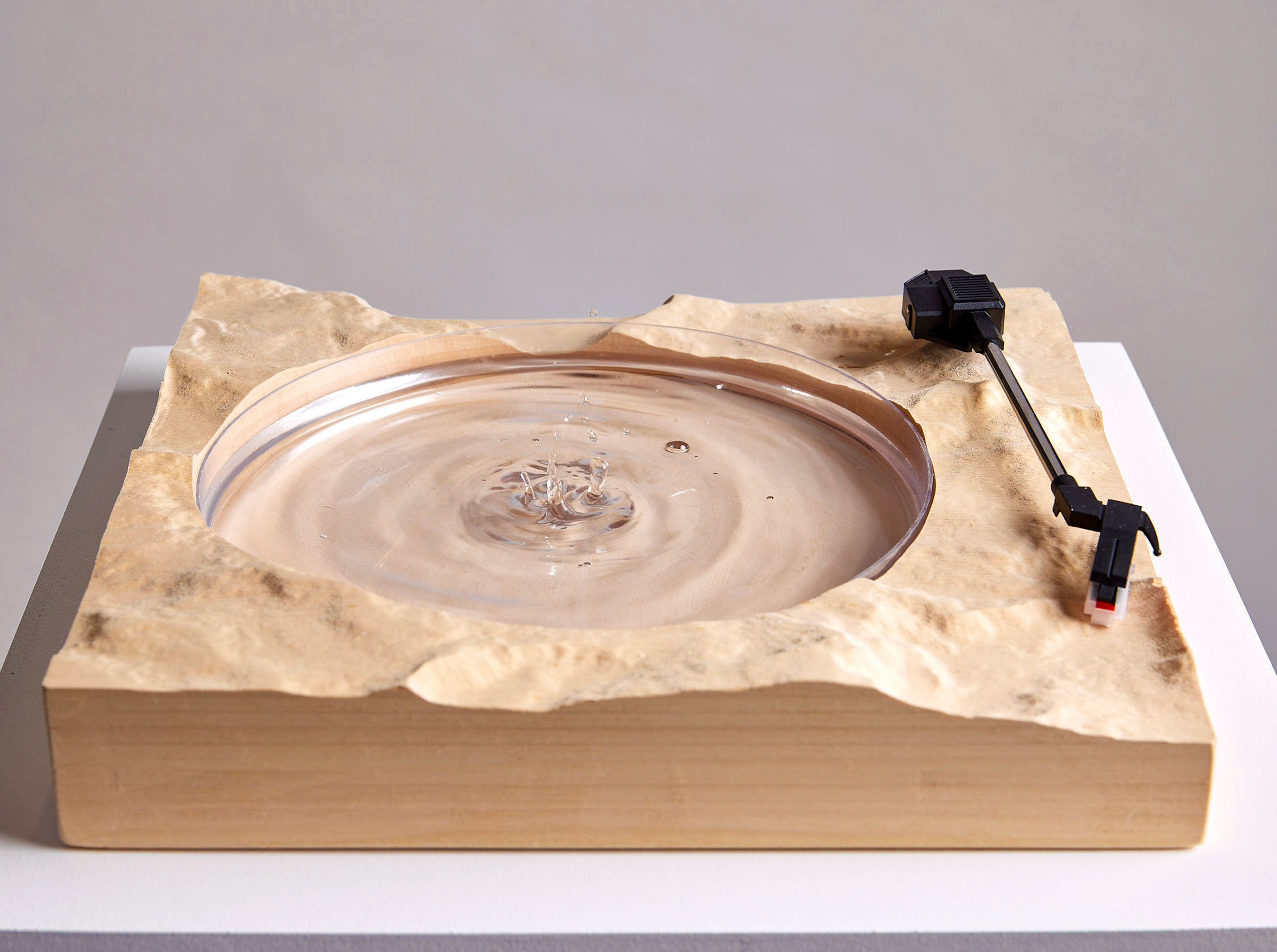
Installation view.
A generative absence
A termite colony may live for decades, but in this story, what matters most is not its life, but what remains after its disappearance.
When a colony dies, its mound does not become inert. Abandoned termite mounds are gradually inhabited by dozens of other species, drawn by altered soil composition, accumulated minerals, and the shelter these structures provide. Among these ecological relationships, the entanglement between termites and elephants stands out as particularly remarkable—a long-standing relationship of provision and dependency that has unfolded over millennia.
Elephants are drawn to the remnants of termite mounds because of the clay’s high concentration of salts and nutrients. When rainfall transforms this clay into a dense, adhesive mud, elephants return to wallow in it. Beyond cooling their bodies, this mineral-rich coating protects their skin from sunburn and biting insects. What was once shaped by termites becomes a site of care for another species.
Each time a family of elephants visits these sites, their immense weight compresses the soil. Gradually, shallow depressions form. Over years, these indentations deepen, collecting water and organic matter, eventually transforming into small oases—microhabitats that support a wide range of plants and animals. The mound, once a termite structure, becomes a generative landscape through repeated use.
Vibratory “head-banging” behaviour in termites, courtesy of Prof. David Sillam-Dussès (University Sorbonne Paris Nord, LEEC).
Vibration as form
Beneath this visible transformation lies a subtler layer of communication: vibration. Vibratory behaviours are widespread among social insects, yet remain one of the least explored modes of communication. In subterranean environments, where visual and chemical signals are limited, vibrations provide an efficient means of transmitting information through the ground.
In termites, vibratory behaviours—such as body-shaking—are performed in multiple contexts, including alarm signalling and reproductive regulation. These vibrations travel through the substrate and can be detected by other members of the colony, though their structure—duration, rhythm, and amplitude—has been only sparsely studied.
Elephants also rely on vibration as a sensory mode. Alongside sight, smell, and sound, they detect seismic information transmitted through the ground. These vibrations include signals produced by other elephants, but also biotic cues often dismissed as background “noise.” Together, they form a shared vibrational field—one in which multiple species are unknowingly attuned to one another.
The Termite and the Elephant proposes a speculative translation of this hidden dialogue. Through sculpture, vibrational patterns are reimagined as form, echoing the logic of a record player—an object designed to read grooves, pressure, and resonance. The work frames ecology as a layered composition, suggesting that life unfolds not only through visible action, but through accumulated rhythms that persist in soil, bodies, and time.